
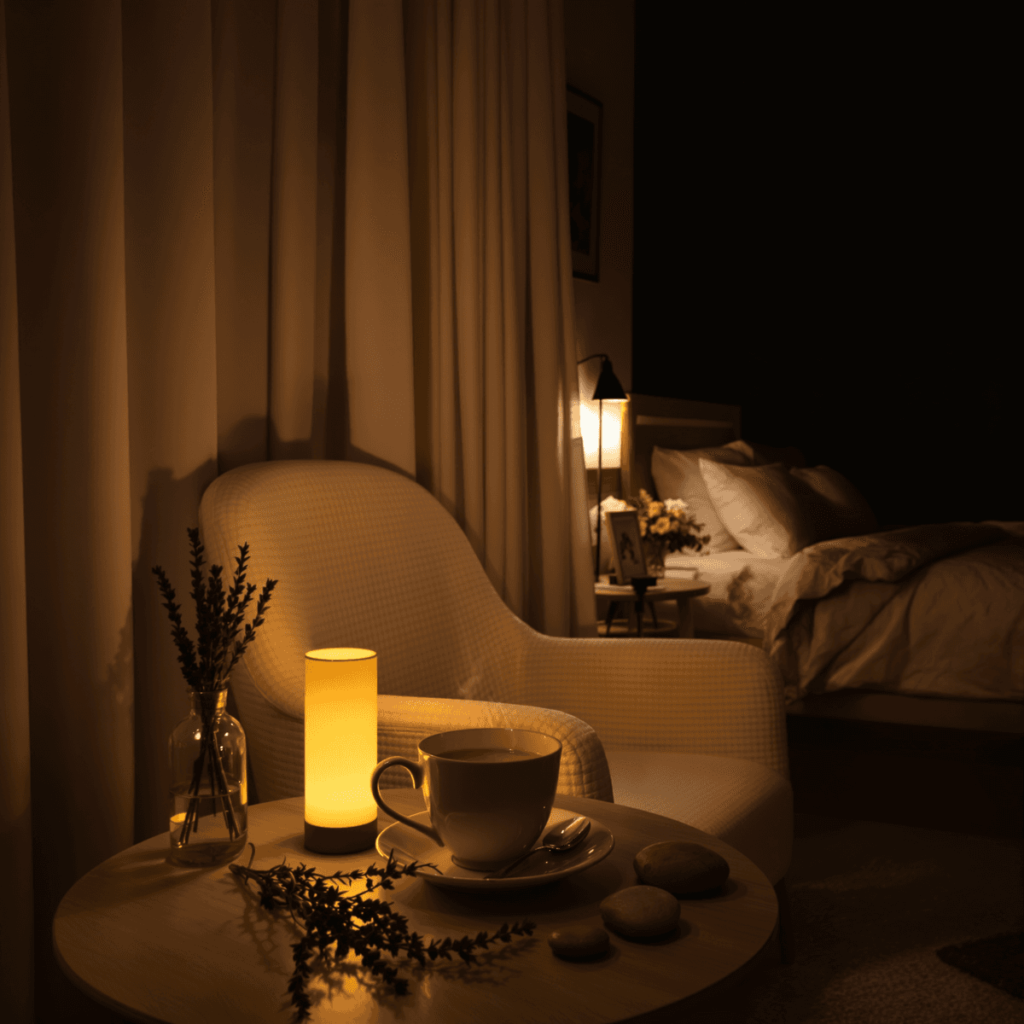
Cozy bedroom at night with warm lighting, a comfortable chair, glowing lamp, steaming herbal tea, lavender sprigs, smooth stones, and a bed in the background.
If you overthink, you know the frustration of lying in bed while your mind races through tomorrow’s tasks, replaying conversations, or spiraling into worries. Developing a night routine can help quiet your mind and prepare your body for sleep. Here are 11 soothing habits to incorporate into your evening routine (night routine for overthinkers):
1. Write a to-do list: Write down your tasks for the next day to clear your mind.
2. Limit screen time: Avoid electronic devices(Phone/Tablet/Laptop/etc.) at least an hour before bed to reduce stimulation.
3. Read a book: Reading a book is a calming activity that takes your mind off worries.
4. Practice deep breathing: Slow, deep breaths can activate the body’s relaxation response.
5. Listen to calming music or sounds: Soothing melodies or nature sounds can quiet you into sleep.
6. Take a warm bath: A relaxing bath can ease tension and promote relaxation.
7. Use aromatherapy: Lavender, chamomile, or other soothing scents can help induce sleep.
8. Practice gratitude: Reflect on positive aspects of your day to shift focus away from worries.
9. Meditate: Spend a few minutes in mindfulness meditation to quiet your thoughts.
10. Stretch or do gentle yoga: Release physical tension with gentle stretches before bed.
11. Use a weighted blanket: The added pressure can promote relaxation and reduce anxiety.
Incorporating these habits into your night routine can help calm an overactive mind and improve the quality of your sleeping into “what-if” scenarios. This mental hyperactivity makes it incredibly difficult to sleep faster, leaving you exhausted and anxious about the next day.
A well-crafted night routine for overthinkers can break this cycle. By incorporating soothing habits into your evening, you create a buffer zone between your active day and restful sleep. These intentional practices signal your brain that it’s time to power down, helping you transition from mental chaos to calm.
In this article, I’ll walk you through 11 soothing habits specifically designed to help overthinkers quiet their minds and drift off more easily. Each habit serves as a practical tool in your soothingscript for better sleep quality and more peaceful nights.
Understanding Overthinking and Its Impact on Sleep
Overthinking is the mental habit of dwelling on thoughts repetitively, analyzing situations from every possible angle, and replaying conversations or scenarios long after they’ve ended. When you’re an overthinker, your brain doesn’t simply switch off when your head hits the pillow. Instead, it kicks into high gear, processing the day’s events, worrying about tomorrow’s tasks, or spiraling into hypothetical scenarios that may never occur.
This mental hyperactivity creates significant sleep disruption. Your racing thoughts activate the sympathetic nervous system—your body’s stress response—which increases cortisol levels and keeps you in a state of alertness when you should be winding down. The result? You lie awake, watching minutes turn into hours, while your mind jumps from one concern to another.
The cycle becomes self-perpetuating. Poor sleep leads to increased anxiety and reduced emotional regulation the next day, which then fuels more overthinking the following night. Your brain begins associating bedtime with this mental marathon, creating a conditioned response that makes falling asleep even more challenging.
The Importance of a Consistent Night Routine for Overthinkers
Your brain loves predictability, especially when it comes to sleep. A consistent bedtime routine is like a signal that tells your mind and body it’s time to switch from the busyness of the day to relaxation mode. When you do the same calming activities every night, you create what sleep researchers call “sleep signals”—actions that trigger your body’s natural relaxation response.
For overthinkers, this consistency becomes even more important. Your mind naturally looks for patterns and structure, and a predictable night routine provides exactly that framework. Instead of lying in bed wondering what you should do to fall asleep, you follow a familiar path that’s already proven to work.
The winding down part of your routine serves multiple purposes:
- Gradually lowers cortisol levels (your stress hormone)
- Activates your parasympathetic nervous system, which promotes relaxation
- Creates mental distance from the day’s stressors
- Provides a sense of control that anxious minds desperately need
When you set aside 30-60 minutes for calming activities before bed, you allow your racing mind to naturally slow down instead of forcing it to shut off suddenly.
1. Creating a Screen-Free Wind-Down Period
Your phone, tablet, and laptop emit blue light that tricks your brain into thinking it’s still daytime. This artificial light directly suppresses melatonin production—the hormone responsible for making you feel sleepy. For overthinkers already battling racing thoughts, this melatonin suppression creates an additional barrier to falling asleep quickly.
Practical strategies for avoiding electronics before bed:
- Set a firm screen cutoff time at least 60-90 minutes before your target bedtime
- Place your devices in another room to remove the temptation of “just one more scroll”
- Replace scrolling with calming alternatives like reading a physical book, journaling your thoughts, or practicing gentle stretches
- Use your phone’s built-in screen time limits or apps that automatically dim your display as bedtime approaches
If completely avoiding electronics before bed isn’t realistic for your lifestyle, blue-light blocking glasses offer a compromise solution. These specialized glasses filter out the wavelengths that interfere with melatonin production, allowing you to use devices when necessary while minimizing sleep disruption. This Night Routine for Overthinkers habit creates the foundation for the calming practices that follow.
2. Engaging in Calming Practices
Your racing mind needs tangible tools to shift from hyperactive thinking to restful calm. Meditation techniques like mindfulness or guided imagery create mental space between you and your thoughts, allowing you to observe them without getting caught in their spiral. I’ve found that even five minutes of focused meditation can dramatically reduce the mental noise that keeps you awake.
Deep breathing exercises work by activating your parasympathetic nervous system—the body’s natural relaxation response. The 4-7-8 method is particularly effective: breathe in through your nose for 4 counts, hold for 7, then exhale through your mouth for 8. This pattern slows your heart rate and signals your body that it’s safe to rest.
Progressive muscle relaxation targets the physical manifestation of overthinking. You systematically tense and release each muscle group, starting from your toes and moving upward. This practice releases the tension you’ve been carrying in your shoulders, jaw, and neck throughout the day.
Adding gentle yoga stretches like child’s pose or legs-up-the-wall pose combines physical release with mindful breathing, creating a powerful pre-sleep ritual that addresses both mental and physical restlessness.
3. Journaling or Writing To-Do Lists Before Bed
Journaling at night serves as a mental download, transferring the swirling thoughts from your mind onto paper. When you write down what’s occupying your headspace, you create distance between yourself and those persistent worries. This practice of organizing thoughts gives your brain permission to let go, knowing that everything important has been captured and won’t be forgotten.
The act of reducing mental clutter through writing provides a sense of completion that your overthinking mind craves. You can try different approaches to find what resonates:
- Brain dump journaling: Set a timer for 10 minutes and write everything that comes to mind without filtering or organizing
- Tomorrow’s to-do list: Write down 3-5 tasks you need to accomplish the next day, then close the notebook
- Gratitude journaling: List three specific things you appreciated about your day, shifting focus from anxious thoughts to positive reflections
- Worry time: Dedicate a specific page to concerns, then physically close the journal to symbolize putting those worries aside
The key is keeping your writing session brief and contained—you’re not solving problems at bedtime, just acknowledging them.
4. Reading Under Soft Lighting Outside the Bedroom
Pre-sleep reading habits can transform your Night Routine for Overthinkers when done strategically. The key lies in selecting non-stimulating reading material that gently occupies your mind without triggering intense emotional responses or intellectual engagement. Think light fiction, poetry collections, or familiar comfort reads rather than psychological thrillers or work-related content that might spark new thought spirals.
Creating a dedicated reading nook outside your bedroom serves a critical purpose: it preserves your sleeping space as a sanctuary exclusively for rest. When you consistently read in bed, your brain begins associating that environment with wakefulness and mental activity, making it harder to fall asleep when you actually need to.
Set up your reading area with soft lighting—a warm-toned lamp positioned to illuminate your book without straining your eyes works perfectly. Avoid overhead lights or bright white bulbs that can interfere with melatonin production. This gentle illumination signals to your body that the day is winding down while still allowing you to enjoy your reading ritual comfortably.
5. Optimizing the Sleep Environment for Overthinkers
Your bedroom environment plays a significant role in how quickly you fall asleep. For overthinkers, creating a cool dark quiet room becomes even more critical because environmental distractions can fuel racing thoughts.
The ideal temperature for sleep ranges between 60-67°F (15.6-19.4°C). I’ve found that starting at 65°F and adjusting based on your comfort level works well for most people. When your room is too warm, your body struggles to initiate the natural temperature drop needed for sleep onset, which can keep your mind alert and active.
Minimizing noise and light requires strategic interventions:
- Install blackout curtains to eliminate street lights and early morning sun exposure
- Use earplugs if you live in a noisy area or have disruptive household sounds
- Run a white noise machine to mask unpredictable sounds that might trigger anxious thoughts
- Cover or remove electronic devices with LED lights that create visual distractions
These adjustments transform your bedroom into a sanctuary that supports your brain’s transition from wakefulness to sleep, reducing the sensory inputs that often keep overthinkers mentally engaged.
6. Taking a Warm Bath Before Bedtime (Optional)
A warm bath triggers a fascinating physiological response that benefits overthinkers struggling with sleep. When you soak in warm water, your body temperature rises temporarily. Once you step out, your core temperature drops rapidly—this mimics the natural temperature decline your body needs to initiate sleep onset. The warm water also relaxes tense muscles that often accompany anxious thinking patterns throughout the day.
Key considerations for bath timing and temperature:
- Keep water temperature between 104-109°F (40-43°C)—hot enough to relax but not so hot that it overstimulates your nervous system
- Schedule your bath 60-90 minutes before bedtime to allow adequate cooling time
- Limit soaking to 10-20 minutes to prevent excessive body temperature elevation
- Add Epsom salts to enhance muscle relaxation and create a more spa-like experience
If you find yourself feeling too alert immediately after bathing, you’re likely bathing too close to bedtime or using water that’s too hot. Adjust these variables until you discover your personal sweet spot for inducing drowsiness.
7. Listening to Calming Sounds or Music Before Sleep (Optional)
Your overactive mind needs something gentle to focus on instead of spiraling thoughts. Calming music for sleep works by giving your brain a neutral anchor point—something that’s engaging enough to distract from anxious thinking but soothing enough not to stimulate you further.
Nature Sounds
Nature sounds like rainfall, ocean waves, or forest ambiance naturally slow your heart rate and breathing patterns. These audio choices create a predictable, repetitive pattern that your mind can follow into relaxation.
White Noise
White noise benefits extend beyond simple distraction—consistent sound frequencies mask sudden environmental noises that might jolt you awake or prevent you from falling asleep. You can use white noise machines, apps, or even a fan to create this buffer.
Ambient Sounds
Ambient sounds for relaxation include binaural beats, soft instrumental music (think piano or acoustic guitar), or specialized sleep soundscapes designed specifically for overthinkers. The key is choosing audio without lyrics or dramatic changes in volume, which can re-engage your analytical mind.
This simple addition to your night routine for overthinkers creates an auditory environment that supports rather than sabotages your sleep efforts.
8. Avoiding Sleep Disruptors Like Heavy Meals and Stimulants (Optional)
Your Night Routine for Overthinkers needs to account for what you consume hours before bedtime. Caffeine avoidance before bed becomes critical when your mind already races—stimulants amplify anxious thinking patterns and keep your nervous system activated when it should be winding down. I recommend cutting off caffeine at least six hours before sleep, which means if you’re aiming for a 10 PM bedtime, your last cup should be around 4 PM.
Heavy meal timing at night matters just as much. Large dinners force your digestive system to work overtime, creating physical discomfort that feeds into mental restlessness. Aim to finish substantial meals 3-4 hours before bed. Alcohol effects on sleep quality deserve attention too—while it might help you fall asleep initially, it disrupts your sleep cycles later in the night, leaving you groggy and more prone to anxious thoughts the next evening.
FAQs (Frequently Asked Questions)
What challenges do overthinkers face with sleep and how can a calming night routine help?
Overthinkers often experience racing thoughts at night, leading to sleep disruption and difficulty falling asleep. A calming night routine helps by signaling the brain to wind down, reducing anxiety and promoting better sleep quality through soothing habits.
Why is establishing a consistent night routine important for overthinkers?
A consistent bedtime routine sends clear sleep signals to the brain, making it easier for overthinkers to relax and drift off. Incorporating soothing activities during the winding-down phase helps quiet an overactive mind and improves overall sleep quality.
How does avoiding screens before bed benefit overthinkers struggling with sleep?
Electronic screens emit blue light that suppresses melatonin production, which is crucial for sleep onset. Overthinkers benefit from a screen-free wind-down period as it reduces stimulation and helps their minds calm down, facilitating faster and more restful sleep.
What calming practices can overthinkers incorporate into their night routine to promote better sleep?
Overthinkers can engage in meditation techniques like mindfulness or guided imagery, deep breathing exercises such as the 4-7-8 method, progressive muscle relaxation, and gentle yoga stretches. These practices help quiet racing thoughts and release physical tension before bedtime.
How can journaling or writing to-do lists before bed improve sleep for overthinkers?
Journaling or making to-do lists helps clear mental clutter by organizing thoughts and providing a sense of closure. This practice reduces anxiety caused by racing thoughts, making it easier for overthinkers to relax and fall asleep faster.
What are some tips for optimizing the sleep environment specifically for overthinkers?
Creating a cool (60-67°F), dark, and quiet bedroom environment is essential. Using blackout curtains, earplugs, or white noise machines minimizes disruptions. Tailoring the room temperature within the ideal range helps regulate body temperature and supports restful sleep for those prone to overthinking.
Another helpful tip for overthinkers is to remove electronic devices from the bedroom. The blue light emitted by screens can interfere with the production of melatonin, a hormone that regulates sleep. Instead, engage in relaxing activities before bed, such as reading a book or practicing meditation, to calm the mind and prepare for sleep.